FishProfiles.com Message Forums |
| faq | etiquette | register | my account | search | mailbox |
 | Mega Powerful Nitrate and Phosphate Remover - DIY! |
santamonica Enthusiast Posts: 152 Kudos: 17 Registered: 19-Sep-2008   | Update: N and P are invisible: It's important to know/remember that Inorganic Nitrate and Inorganic Phosphate, which is what your test kits read, and which are also what causes the nuisance algae to grow in your tank, are invisible. You can see the results of the nitrate and phosphate; it's the nuisance algae. But you cannot see the nitrate and phosphate itself. This fact causes the most problems when people see a lot of stuff (food) that their skimmers have removed, but wonder why their nuisance algae is not being removed (skimmers don't remove Inorganic Nitrate and Inorganic Phosphate), and also when their phosphate tests zero, but they still have algae on certain parts of the rocks (the invisible phosphate is coming out of the rocks.) 888-CORAL-REEF Filtering discussion: www.AlgaeScrubber.net |
 Posted 10-Mar-2009 09:37 Posted 10-Mar-2009 09:37 |       |
| santamonica Enthusiast Posts: 152 Kudos: 17 Registered: 19-Sep-2008 | Update: FW cleanings Pods eating the algae: The reason you need to run freshwater over your screen every week is because you want to kill the baby pods that start to grow and eat the algae. You may not see the eaten areas, unless the algae is very thin like this: 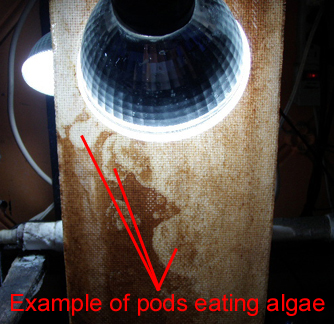 However, pods are always growing and multiplying. And they eat algae. The reason this is a problem is that (1) pods are constantly flowing out of your scrubber into the tank. If they eat algae first, then the nitrate and phosphate that is in that algae gets released back into the water, and (2) you now have less algae to do the filtering. Unlike the picture above, however, the algae is usually too thick for the eaten areas to be seen. The pods stay out of the light, in the underlying la 888-CORAL-REEF Filtering discussion: www.AlgaeScrubber.net |
| Posted 12-Mar-2009 04:19 | |
| santamonica Enthusiast Posts: 152 Kudos: 17 Registered: 19-Sep-2008 | Successes Update: sean48183 on the SWF site: "Alright, just tested NO3 and ta da! 0 NO3! Awesome. Still have some hair algae in display, but appears to have slowed down. My scrubber is still getting mostly brown slime and some green. Don't really care. It is working. Have to clean every couple days because it is growing so fast. Anyone who is debating trying -- quit debating and just do it." ScubaDrew on the RS site: "I built a small one using the basic plans posted in the first few pages. I used a dremmel to cut the slot in the PVC and used fishing line through the small holes in the plastic divider material to hold it up. My tank measured 0’s in all the algae related categories prior to building it, but my tank was still growing a lot of HA and some cyano. I’ve only got one florescent ‘flood’ style light on one side of the scrubber right now due to having placed it in an already crowded sump. I had a full coat of algae in about 10 days, and cleaned off about ¾ of what had accumulated at that time. Now I need to clean off a large, heavy, handful every week! With continued cleaning in my DT, I’ve really made progress in getting the DT algae free. Thanks for the info, I think the ATS will be a part of my system for a long time to come." RiaanP on MASA site: "Scrubber running now for four weeks. NO3 0mg/l (first time EVER). PO4 between .025 and 0.5 mg/l. 4 weeks ago NO3 was over 100 mg/l and PO4 was over 2 mg/l. So a scrubber really works." 888-CORAL-REEF Filtering discussion: www.AlgaeScrubber.net |
| Posted 14-Mar-2009 22:55 | |
| santamonica Enthusiast Posts: 152 Kudos: 17 Registered: 19-Sep-2008 | Part 2 of 7: Taken from "From the Food of Reefs to the Food of Corals" by Eric Borneman http://www.reefkeeping.com/issues/2002-08/eb/index.php "Nitrogen levels in [natural] coral reef waters are typically extraordinarily low, with most being found as ammonia. This is in contrast to aquaria, where the dominant nitrogen species is usually nitrate. Nitrogen is the be-all end-all for zooxanthellae growth and reproduction [zooxanthellae is what photosynthesizes light into food for corals]. By limiting nitrogen in the form of excretion products, the [coral] polyps keep the zooxanthellae in the numbers and density that maximize photosynthetic efficiency for its own use. Using several released compounds, most of which are still unidentified, the [coral] polyp stimulates the zooxanthellae to release virtually all of the products of its photosynthesis, and these are then used by the polyp for its own needs. If nitrogen was made readily available to the zooxanthellae (for example, if high levels were present in the water and this dissolved nitrogen diffused into the coral tissue), it could then be accessed by the algae without limitation by the polyp, and zooxanthellae could begin to grow and reproduce like a phytoplankton culture. In this case, the symbiosis becomes less advantageous to the coral, and it will expel some of the symbionts to try and re-establish maximal benefit from its algal partners. As a practical note, when very high densities of zooxanthellae exist in coral tissue [because of to much nitrogen], the resultant coloration of the coral is usually a rich or dark brown color. "Coral mucus, in turn, and as was shown in the previous article, is itself a food source to the reef. [Skimmer remove mucus, but do not remove nitrogen] 888-CORAL-REEF Filtering discussion: www.AlgaeScrubber.net |
| Posted 16-Mar-2009 02:24 | |
| santamonica Enthusiast Posts: 152 Kudos: 17 Registered: 19-Sep-2008 | Question: Anyone know where to buy marine self-priming pumps? Several people are trying to build the top-of-nano scrubber I posted, but in order to put the pump in the scrubber (and thus not in the display), the pump needs to be able to pull water up and out of the display. So far, the only thing found is the Eclipse nano hoods with small pumps built in, and a few other HOB filters with small self-priming pumps built in. But these are built-in and molded to the other parts. What is really needed is a self-contained pump that is separate from the other parts, and which of course is aquarium safe, and in the 70 to 150 gph range (266 to 570 lph). 888-CORAL-REEF Filtering discussion: www.AlgaeScrubber.net |
| Posted 19-Mar-2009 08:11 | |
| santamonica Enthusiast Posts: 152 Kudos: 17 Registered: 19-Sep-2008 | Update: Nutrients vs. Nutrition It's important to understand the difference between these two words. "Nutrients" generally means Inorganic Nitrate and Inorganic Phosphate, which are the things that you measure with your test kits, and which are also the things that nuisance algae feed on. "Nutrition", however, generally means food for corals and fish. Natural reefs in the ocean are high in "nutrition" (lots of food particles floating around), but low in "nutrients" (nitrate and phosphate). Aquariums that have skimmers, or other mechanical filters like foam or floss, are low in nutrition because the food is filtered out, but they are high in nutrients because the Inorganic Nitrate and Inorganic Phosphate is not filtered. Aquariums that have only scrubbers are high in nutrition but low in nutrients. Aquariums with both skimmers and scrubbers are low in both nutrition and nutrients. 888-CORAL-REEF Filtering discussion: www.AlgaeScrubber.net |
| Posted 21-Mar-2009 22:45 | |
| santamonica Enthusiast Posts: 152 Kudos: 17 Registered: 19-Sep-2008 | Part 7 of 7: "The Food of Reefs, Part 7: Dissolved Nutrients" by Eric Borneman http://reefkeeping.com/issues/2003-04/eb/index.php "Mucus consists of mainly sugars and glycoproteins - soluble materials in and of themselves. However, the formation of mucus, and its release in a matrix of chains of these materials, may result in a particulate material. This material is both utilized directly by many organisms, and also forms the basis for a predominant fraction of the particulate "marine snow" on reefs. "In fact, reef waters are 30-40% higher in DOM [disolved organic matter] than oceanic waters. "In terms of determining the degree to which organisms may use dissolved material as significant source of nutrition, one may examine the surface area of the outer cell membranes exposed to such materials. In general, the larger the absorptive area, the more likely organisms are to depend on absorption. Some cell surfaces are covered with many finger-like processes called microvilli that greatly increase the surface area of the membrane. Furthermore, the presence of cilia is often a good indicator of absorptive surfaces. Perhaps not surprisingly, corals have extensive microvilli and cilia. "Corals are able to take up various forms of both organic and inorganic dissolved nitrogen. "Even slightly elevated nitrogen levels can quickly result in rapid increases in the density of zooxanthellae, as they use it to fuel their own reproduction" [and thus turn the coral brown] "It is also somewhat equivocal that corals are able to utilize nitrate (which exists nearly totally in its ionic state at physiological pH) at all, and an inability to find nitrate reductase in many studies, makes the ultimate importance of this dissolved nitrogen source to corals (and anemones) rather tenuous. However, it is unambiguously true that ammonium is a sought-after nitrogen source by both coral host and algal partner. "Humic (refractory) compounds: These yellowing compounds are typically found at relatively high levels in aquaria, and they are removed with protein skimming and activated carbon. Humic materials have been thought to be relatively inert and unavailable for use as a nutrient source. However, studies have shown that organisms from bacteria to brine shrimp (Artemia salina) can utilize humic substances as a source of nutrients. "In terms of corals reefs, the amounts of most dissolved nutrients, except carbon in most cases, are very low. "The higher nutrient levels may cause corals and other symbiotic partnerships to decline as the partner algae preferentially utilize the increased nutrient sources to the expense of the host. [and thus browning of the coral occurs] "Without question, corals and many reef organisms are able to utilize dissolved nutrients to help meet their energy requirements and to use in tissue growth. 888-CORAL-REEF Filtering discussion: www.AlgaeScrubber.net |
| Posted 24-Mar-2009 02:57 | |
| santamonica Enthusiast Posts: 152 Kudos: 17 Registered: 19-Sep-2008 | Anyone still reading this thread and want me to keep posting? I'm doing some cleanup... 888-CORAL-REEF Filtering discussion: www.AlgaeScrubber.net |
| Posted 28-Mar-2009 07:43 | |
FRANK       Moderator Posts: 5108 Kudos: 5263 Votes: 1690 Registered: 28-Dec-2002   | Hi, Actually, I have read every single one of your postings and looked at every picture. But... I've a freshwater tank! The information that you have posted here over the years is invaluable to someone in the marine environment, and should I switch over to the "dark side" I would follow your advice and examples. Your posts seemed to be a log of your experiences, and not necessarily one urging replies or comments. I've always figured that you were corresponding with your readers on the side, and thus never posted here, until now. I'd vote for you to continue with your postings. Frank  -->>> The Confidence of Amateurs, is the Envy of Professionals <<<-- |
| Posted 14-Sep-2009 16:42 | |
| santamonica Enthusiast Posts: 152 Kudos: 17 Registered: 19-Sep-2008 | New scrubber update: The new design will not require a slot in the pipe. If you have not built one yet, and you have trouble with DIY, then you might wait for the new DIY plans to be posted; there should be no hard-to-cut pieces (like a slot), at least for the very simple versions. 888-CORAL-REEF Filtering discussion: www.AlgaeScrubber.net |
| Posted 18-Feb-2012 01:03 | |
| FRANK Moderator Posts: 5108 Kudos: 5263 Votes: 1690 Registered: 28-Dec-2002 |  Edited 19-Feb-2012 20:14 Edited 19-Feb-2012 20:14I'd thought you had abandoned ship. Hope all is well and we look forward to your postings. Frank -->>> The Confidence of Amateurs, is the Envy of Professionals <<<-- |
| Posted 18-Feb-2012 14:54 | |
| santamonica Enthusiast Posts: 152 Kudos: 17 Registered: 19-Sep-2008 | Thanks. I just got a bit busy with the day job stuff. But I'll be spending more time on the new designs, since they are nano-friendly and dirt-cheap to make (everyone probably has all the parts to make them already.) 888-CORAL-REEF Filtering discussion: www.AlgaeScrubber.net |
| Posted 18-Feb-2012 19:08 | |
| santamonica Enthusiast Posts: 152 Kudos: 17 Registered: 19-Sep-2008 | Here is a comparison of the types of bulbs to use:  888-CORAL-REEF Filtering discussion: www.AlgaeScrubber.net |
| Posted 29-Feb-2012 04:16 | |
| santamonica Enthusiast Posts: 152 Kudos: 17 Registered: 19-Sep-2008 | Less than 2 weeks until the new design is posted... 888-CORAL-REEF Filtering discussion: www.AlgaeScrubber.net |
| Posted 18-Apr-2012 03:36 | |
| santamonica Enthusiast Posts: 152 Kudos: 17 Registered: 19-Sep-2008 | Phosphate flow out of rocks Many people, when they get their scrubber running for the first time, get worried when more (not less) algae starts to grow on their rocks. It seems really strange, especially when nitrate and phosphate have gone lower than before. What is happening is that phosphate is coming out of the rocks. Remember, phosphate is invisible, so you can only see the effects of it, and it always "flows" from higher concentrations to lower concentrations (just like heat does). Example: If your room is warm, and you put a cold ob Think of phosphate as the heat, and your rocks as the ob This flow causes an interesting thing to happen. As the phosphate comes out of the rocks, it then becomes available to feed algae as soon as the phosphate reaches the surface of the rocks where there is light. So, since the surface of the rocks is rough and has light, it starts growing MORE algae there (not less) as the phosphate comes out of the rocks. This is a pretty amazing thing to see for the first time, because if you did not know what was happening you would probably think that the algae in the scrubber was leaking out and attaching to your rocks. Here are the signs of phosphate coming out of the rocks: 1. The rocks are older, and have slowly developed algae problems in the past year. 2. The scrubber is new, maybe only a few months old, and has recently started to grow well. 3. Nitrate and phosphate measurements in the water are low, usually the lowest they have been in a long time. 4. Green hair algae (not brown) on the rocks has increased in certain spots, usually on corners and protrusions at the top. 5. The glass has not needed cleaning as much. Since skimmers, filter socks, etc don't remove any nitrate and phosphate, and waterchanges and macro's in a fuge don't remove much, most people have never seen the effects of large amounts of phosphate coming out of the rocks quickly. But sure enough, it does. How long does it continue? For 2 months to a year, depending on how much phosphate is in the rocks, how strong your scrubber is, and how many other phosphate-removing filters you have (GFO, carbon dosing, etc). But one day you will see patches of white rock that were covered in green hair the day before; this is a sure sign that the algae are losing their phosphate supply from the rocks and can no longer hold on. Now it's just a matter of days before the rocks are clear. 888-CORAL-REEF Filtering discussion: www.AlgaeScrubber.net |
| Posted 16-Nov-2013 04:36 | |
| santamonica Enthusiast Posts: 152 Kudos: 17 Registered: 19-Sep-2008 | Very nice scrubber-only tank: http://algaescrubber.net/forums/showthread.php?2702-180g-Show-Tank&p=35853&viewfull=1#post35853 His personal page: http://home.comcast.net/~dgrigor/ 888-CORAL-REEF Filtering discussion: www.AlgaeScrubber.net |
| Posted 11-May-2014 00:26 | |
| santamonica Enthusiast Posts: 152 Kudos: 17 Registered: 19-Sep-2008 | Coming this summer 2016: Waterfall algae scrubber Version 2 After I invented the waterfall scrubber in 2008, it's great that so many people got to DIY it, and it's also great that lots of builders/sellers used it as their design up until the current day. It's had over 7 years to gather hobbyists. 2012 was a good year though, when I introduced the upflow scrubber. It's only had 3 years to gather hobbyists, but offers them what they did not have before: a compact place where they can put a scrubber that does not spill over when it fills up. Now that the upflows are established, it's time to do some more work on the waterfalls. They've been unchanged since 2008, and almost every part of them can be improved. So over the next year or two I'll post up the improvements piece by piece. Hopefully the improvements will be useful to all. 888-CORAL-REEF Filtering discussion: www.AlgaeScrubber.net |
| Posted 27-Jan-2016 20:40 | |
 Pages: 1, 2, 3, 4, 5, 6, 7, 8 Pages: 1, 2, 3, 4, 5, 6, 7, 8 | |
  | |
| Jump to: |
The views expressed on this page are the implied opinions of their respective authors.
Under no circumstances do the comments on this page represent the opinions of the staff of FishProfiles.com.
FishProfiles.com Forums, version 11.0
Mazeguy Smilies